A friend who has sailed a couple of times wrote up this very useful "Life on the Ship" page. For those of you who have not yet visited your "home" for the summer 2014, here's a general idea of how things are.
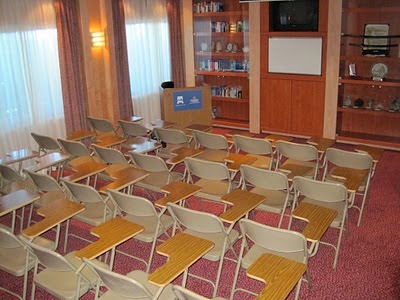
Since most of you haven’t been on the ship, I thought I would try to convey what life on the ship is like. To start with, our ship is named the MV Explorer (the MV stands for Motor Vessel). The ship is a former Mediterranean cruise ship, re-outfitted for instructional purposes. Many of the former lounge areas are now classrooms; the former casino is now the computer lab; and the former bar is now the library. We also have a large classroom, called the Union, where dinner dancing and entertainment used to occur, now serving as an auditorium.
The ship is almost 600 feet in length and has 7 decks. We have two main dining facilities, and a couple of snack bars. There is a spa, where one can get haircuts, manicures, pedicures, massages, and enjoy both sauna and steam room facilities. We have a workout room, containing treadmills, elliptical machines, and stationary bikes. On the 7th deck aft (that’s the rear of the ship), there are free weights and pulley weights for strength-building. There is also a small swimming pool, a ping-pong table, and an outdoor basketball/volleyball court. We have two merchandise stores—one selling sweatshirts and tee shirts with SAS insignia, and the other drugstore items.
The MV Explorer is reported to be the fastest cruise ship on the oceans, with the capacity of hitting 30 knots/hour. It has four, 10,000 hp engines, capable of creating a rooster tail at the rear of the ship. We almost never go this fast for fuel consumption reasons, so we tend to go between 13-20 knots.
The crew comes from all over the world, with much of the wait staff coming from the Philippines. Some of the crew has worked on the ship for years, such as our steward Rey for 13 years. There are two captains in the employ of the Institute for Shipboard Education, which runs Semester at Sea (SAS), but only one on board at a time. There are engineers, accountants, chefs, beauticians, etc. on board-- everyone who would be needed to operate a small community. Most rotate on for 9-10 months and off for 2-3.
The ship is registered in the Bahamas, which accounts for the phenomenon of students having boarded the ship in Halifax rather than a U.S. port. Years ago, Congress passed legislation called the Jones Act, which prohibits a foreign vessel from both loading and unloading passengers in the U.S., as a way of protecting U.S. carriers. A good way to understand this is to consider foreign airplanes. Air France, for example, is not allowed to load passengers in NYC and fly them to Chicago, since it would be competing with American, United, and other U.S airplane companies. Air France could pick up passengers in NYC, but would have to deliver them to another country. In the same way, the MV Explorer, because it is a foreign-registered vessel, can’t pick up and unload passengers in the U.S. So, on our voyage, the students got on in Halifax, Canada and will disembark in Fort Lauderdale. Because faculty members are employees, they are exempt from this Act.
Faculty cabins, on the 4th and 5th decks, are very nice, if small. Some have port holes, some have larger windows looking out on the ocean when we’re at sea. A queen bed or two doubles (that can be put together), a small sofa or curved sitting area, chair, small refrigerator, dressing table (which we use as the laptop computer location), bathroom, and a decent amount of storage space. We also have a TV, with 5 intra-ship channels. One channel always shows our ship’s location, while the other channels play movies and broadcasts events on the ship. Cabin stewards clean the cabin every day, make the bed, change the sheets and towels every few days, deliver our laundry, and bring us ice each day in time for our happy hour. Don’t you all wish you had a steward like that!!!!
On the 7th deck forward, there is a faculty/staff lounge for people to do work (none of the teaching faculty has office space), read, or just relax. From 5-6 and from 9-11 each night while at sea, there is a bar serving drinks, and faculty/staff mingle and share stories and experiences.
Every day that we are at sea, classes are held. Students typically take 12 semester credits, which are offered through UVa. On our voyage, we have about 475 undergraduate students (the ship can hold up to 730), 35 or so faculty members, about 40 staff members (dean of students, resident directors, field experience coordinators, administrative and medical personnel, etc.), family members, and about 35 lifelong learners (there have been as many as 65). Combined with the 200 or so ship personnel, we have around 800 people on board. Ages for the people on board range from 2 to 92 years.
Before arriving in each port, we have a cultural pre-port meeting and a logistical pre-port meeting. The cultural pre-port informs everyone about the country, food, history, things to do, etc. The logistical pre-port addresses issues like the currency, safety and health concerns, etc. Then there are post-ports to encourage thoughtful reflection after visiting a country.
Internet connections on the ship are extremely limited. Because of the narrow bandwidth, no more than 50 people can be online at one time. Connections are often slow and irregular. As a result, we can’t stream video or keep up well with Facebook. This is a particular limitation for faculty accustomed to live access to the web during classes and to students used to doing most of their research online. While this frustration is at times palpable, there is also a real appreciation for simpler means of communications. Most participants make peace with the limits on ship and eagerly seek internet access in ports.
Informal and ad hoc learning experiences occur all the time. For example, people volunteer to teach yoga and photography classes, organize Greek life meetings, lead a choir, hold religious gatherings, and the like. Every evening there are several Explorer or Union Seminars to choose from…programs and speakers across myriad topics. In many ways, life on the ship replicates Thomas Jefferson’s ideal of an “Academical Village,” where faculty and students live and learn together.
Along with some other faculty and lifelong learners, we have an “extended family,” consisting of 5 students. We get together for dinners and provide a “home base” if the students need one. Some of these units seem to coalesce better than others, but we’re pretty pleased with how ours is working out. One night, for example, we met them on the 7th deck to treat them to pizza or burgers, and in a week or so, we’re hosting them for a special dinner, which is a significant upgrade to the regular meals.
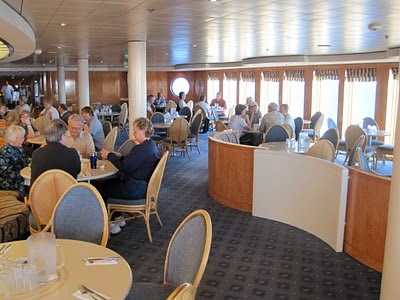
The meals on the ship tend to get monotonous, so we sometimes seek a change of pace on the 7th deck, especially for ice cream soft serve. I will say, however, that the food on this voyage is better than what we had on the 2009 voyage. The fish is much better, and the selection of dishes shows more imagination. I would characterize the food as being “dorm food,” which is why we always seek out nice restaurants when we’re in port. On the ship there are two large dining halls and an outside deck where we join students and/or colleagues for conversation over meals.
When the ship passes the Equator, there is a fun ceremony called, “Neptune Day,” in which the shellbacks (those who have previously crossed the Equator on a ship) initiate the “pollywogs,” those who are crossing for the first time. The rituals remind me of a mild form of hazing, and include such activities as bowing before King Neptune and Queen Minerva, kissing a dead fish, and jumping in the pool to wash off liquids (better left unidentified) that have been poured on the pollywogs. In addition, many pollywogs get their heads shaved, including a number of women. All of these activities are strictly voluntary and people can opt out with no stigma attached. This time, we had a special ceremony because we crossed the Equator on the Prime Meridian, so we were at the point of 0 degrees latitude and 0 degrees longitude that divides the four hemispheres. There’s a special term to describe those who have done this and we’re called “Emerald Shellbacks.”
Later in the voyage, we had the Sea Olympics, pitting the various seas (Bering, Adriatic, etc.) against one another in fun competitions. The students are organized into seas based on where on the ship they live. On the 2009 voyage, the faculty and lifelong learners combined to form the “Nearly Dead Sea”(!) and this time we named ourselves the “Vitamin C.” Events include relay races through the ship, spelling bee, chin-ups, tug-of-war, board games, ping pong tournament, water balloon tosses , etc. Lots of fun and we placed 5th (out of 11) overall this year…very respectable. Other events yet to come are the crew and SAS talent shows, shipboard auction to benefit SAS, final convocation, and the Masquerade Alumni Ball.
Wildlife watching is a regular activity on the ship. People will scan the ocean to see what they can find. Off the African coast, we saw a whale spouting and I made some comment about giving us a Pacific Life moment, when the whale did exactly that by breaching into the air. We all had a good laugh at the timing of the comment. We also saw a good number of flying fish, which jump out of the water just above the surface and glide for 30 feet or so before going back into the ocean. Many dolphin and birds are regularly spotted. Most recently the albatross flew over us regularly approaching South America. The astronomy professor also holds sky-gazing sessions outside on the top deck, with the Southern Cross featured lately.
The ship’s personnel are very environmentally conscious. Every day we get a report on how much water we have consumed per person and how much food garbage was generated each day and the total amount for the voyage.